
Affiliate disclosure: TheTechVector earns a commission if you buy through links on this page, at no extra cost to you. Our recommendations are based on independent research — we are not paid to favour any brand or retailer. Learn more about how we make money.
Finding the best laptop under 50000 in India in 2026 is harder than a year ago — not for lack of choice, but because the specs behind each price tag have quietly slipped. This guide picks five laptops near ₹50,000, settles the 8GB-versus-16GB question, and says whether ₹40,000 or ₹60,000 fits you better.
Last updated: August 2026
Independently researched · No paid placements · Prices checked August 2026

What ₹50,000 actually buys you in a laptop right now
At ₹50,000 in August 2026, a sensible laptop means a 15.6-inch full-HD IPS screen, a 512GB NVMe SSD, and a current-ish processor — Intel Core i5 12th/13th Gen, Intel Core 3 100U, or AMD Ryzen 5 (7520U / 5625U / 7430U). Below that baseline, every compromise should be deliberate.
RAM is where this budget bites. 8GB is the realistic Windows 11 floor in 2026 and what most current configurations ship with here. 16GB still exists under ₹50,000 but is usually soldered and paired with a slower chip. Skip any mechanical hard drive, eMMC drive, or HD (1366×768) or TN panel — all disqualifiers at this price.
You do not get discrete graphics, a metal chassis or a high-resolution screen; the body is plastic and battery life is a realistic five to eight hours. No OLED panel exists under ₹50,000 in India in 2026, whatever a listing claims.
How the 2026 RAM and SSD price crisis reshaped the best laptop under ₹50,000
Laptop prices in India are projected to climb 20–35% across 2026, on a DDR memory price spike (RAM chip prices up roughly 2.5–3x) and an entry-level Intel processor shortage (91mobiles, techdodo.in, 2026). The budget segment is hit hardest — some 2025 models once under ₹35,000 now cost ₹40,000–45,000 (as of August 2026).
That is why a 2026 model can carry worse specs than the 2025 version at the same price: vendors are dropping their cheapest configs and cutting the rest — 8GB where last year had 16GB, slower panels, smaller SSDs. The 2026 ASUS Vivobook 15 refresh (Core 3 100U) now launches just above the line at ~₹52,990–53,990 (techstoriesindia.in, August 2026). Buy now if you need the machine — the memory crunch is expected to last into late 2027, so prices will not fall back soon.
Quick verdict: the best laptops under ₹50,000 right now
Five laptops worth buying near ₹50,000, each with its one-line reason. Prices are August 2026 spot figures — check the live one first.
Value Score is our editorial rating — performance, display/build and price-to-spec weighed from the research below — not a lab benchmark or an aggregated review average.
The best laptop under ₹50,000 in India in 2026 is the ASUS Vivobook 15 (X1504VA), at around ₹44,000–48,000 (as of August 2026) — a 13th Gen Core i5-1335U and a fast 512GB NVMe SSD make it our best overall pick at 8.5/10.
Get ASUS Vivobook 15 →Need to keep 20-plus tabs and background apps open at once? The ASUS Vivobook Go 15 (E1504FA) (~₹41,990, 7.2/10) is the multitasking pick, with genuine 16GB RAM instead of 8GB. If a smoother screen matters more than raw speed, the Dell Pro 15 (2025) (~₹44,490, 7.3/10) is the only laptop here with a 120Hz panel. For the strongest processor-to-price balance, the Lenovo IdeaPad Slim 3 (~₹47,990, 8.0/10) pairs a six-core Ryzen 5 5625U with a free RAM slot for a cheap upgrade later. On the tightest budget, the HP 15s (~₹45,990–49,899, 5.8/10) is fine for browsing and office work, nothing heavier.
| Laptop | CPU | RAM / storage | Display | Approx price (Aug 2026) |
|---|---|---|---|---|
| ASUS Vivobook 15 (X1504VA) | Core i5-1335U (13th Gen) | 8GB / 512GB SSD | 15.6″ FHD 60Hz | ~₹44,000–48,000 |
| ASUS Vivobook Go 15 (E1504FA) | Ryzen 5 7520U | 16GB / 512GB SSD | 15.6″ FHD 60Hz | ~₹41,990 |
| Dell Pro 15 (2025) | Ryzen 5 7520U | 8GB / 512GB SSD | 15.6″ FHD 120Hz | ~₹44,490 |
| Lenovo IdeaPad Slim 3 | Ryzen 5 5625U | 8GB / 512GB SSD | 15.6″ FHD 60Hz | ~₹47,990 |
| HP 15s | Ryzen 3 7320U | 8GB / 512GB SSD | 15.6″ FHD 60Hz | ~₹45,990–49,899 |
Best for most people: ASUS Vivobook 15 (X1504VA). Newest processor of the group, a proper FHD IPS screen, mid-₹40,000s (as of August 2026). 8GB is the catch — plan to add a stick.
Best OverallBest for heavy multitasking: ASUS Vivobook Go 15 (E1504FA). The cheapest real 16GB of RAM here. The Ryzen 5 7520U is modest, but 16GB keeps 20+ tabs and background apps from choking.
Best for MultitaskingBest screen: Dell Pro 15 (2025). A 120Hz anti-glare FHD panel at ~₹44,490 (as of August 2026) is rare under ₹50,000 — scrolling looks noticeably smoother.
Best ScreenBest value engine: Lenovo IdeaPad Slim 3. Six-core Ryzen 5 5625U holds speed under load, with a free RAM slot to move to 16GB cheaply later.
Best ValueBest on the tightest budget: HP 15s (Ryzen 3 7320U). Fine for browsing, office work and streaming, nothing heavier. Only worth it near the bottom of its price range.
Best Budget PickThe five best laptops under ₹50,000, reviewed
ASUS Vivobook 15 (X1504VA) — best laptop under ₹50,000 for most people
The Vivobook 15 X1504VA runs an Intel Core i5-1335U — a 13th Gen, 10-core chip that is a real step up from the 11th and 12th Gen i5s still on sale at this budget. For two dozen browser tabs, Office, Google Meet, light photo edits and a background stream, it does not stutter. It sells for roughly ₹44,382 (cashkr.com, 30 August 2026) to ₹47,990 (Sportskeeda, 8 August 2026), often the cheapest current-generation i5 on the shelf, with a 15.6-inch FHD IPS 60Hz screen (sharp, average brightness) and a fast 512GB NVMe SSD.
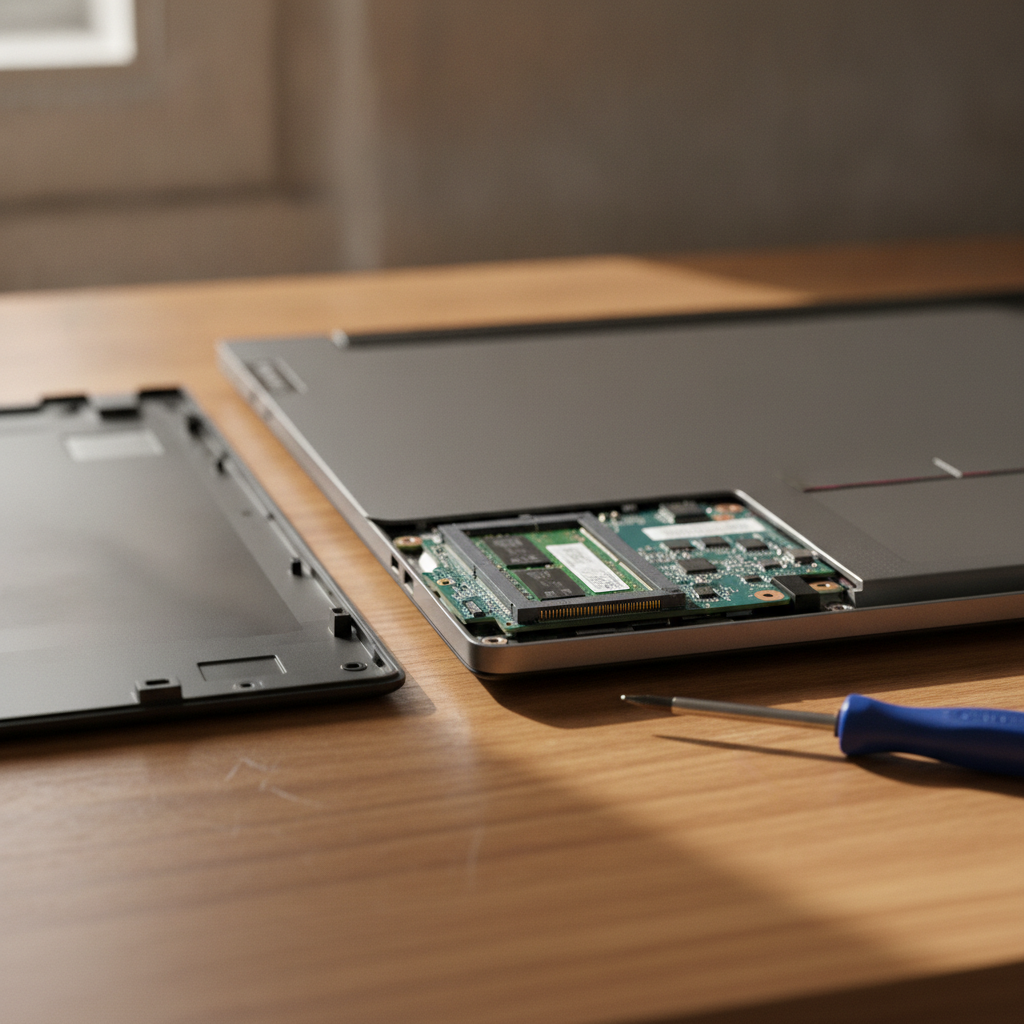
The compromise is 8GB of RAM, part soldered, with one free SO-DIMM slot on most variants — check the model number, it varies. Add an 8GB stick soon after buying (about ₹1,800–2,500 as of August 2026) and it becomes a strong 16GB machine on the best processor here.
Pros
- Newest processor here (Core i5-1335U, 13th Gen)
- Often the cheapest current-gen i5 near ₹45,000 (August 2026)
- Fast 512GB NVMe SSD, comfortable keyboard
- Free RAM slot on most variants
Cons
- Only 8GB RAM out of the box
- 60Hz panel, average brightness
- Slot layout varies by SKU — confirm first
ASUS Vivobook Go 15 (E1504FA) — modest chip, real 16GB RAM at ~₹42,000
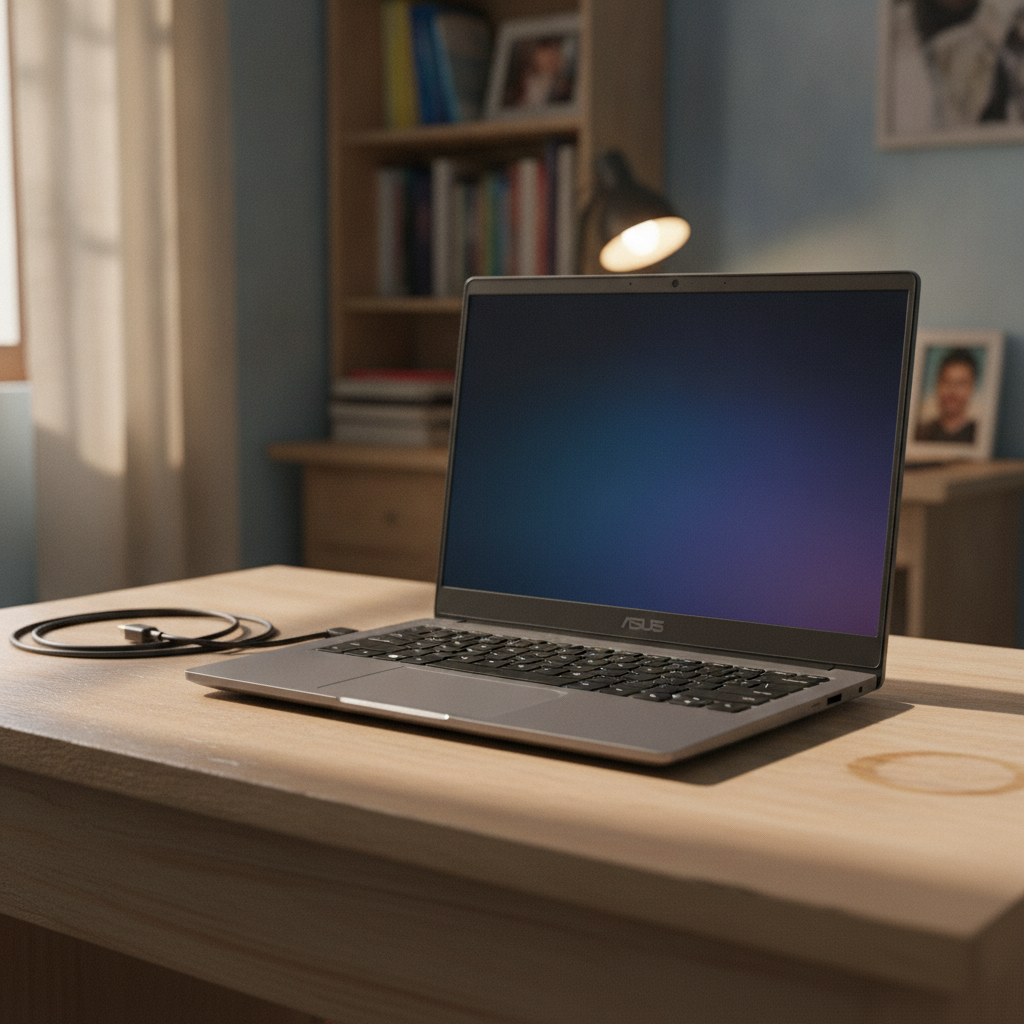
The Vivobook Go 15 E1504FA sells for roughly ₹41,990 (multiple retailers, August 2026) with an AMD Ryzen 5 7520U, 16GB of RAM and a 512GB SSD. The 7520U is a four-core Zen 2 chip and feels slower than the i5-1335U or the Ryzen 5 5625U on any single heavy task. What it has is headroom: with 20-plus tabs, several background apps and a spreadsheet open at once, 16GB stops the machine swapping to disk.
The 16GB is soldered — no upgrade path, no downgrade risk. The screen is a standard FHD panel, the chassis is light plastic, and battery life is average. Do not buy it for exports or compiling; buy it because you keep too many things open.
Pros
- Genuine 16GB RAM at around ₹42,000 (August 2026)
- Handles heavy multitasking without choking
- 512GB SSD, light to carry
- Often the cheapest laptop here
Cons
- Ryzen 5 7520U is slow for single heavy tasks
- RAM is soldered — no future upgrade
- Basic 60Hz screen, average battery
Dell Pro 15 (2025) — a 120Hz panel at a price nobody else matches
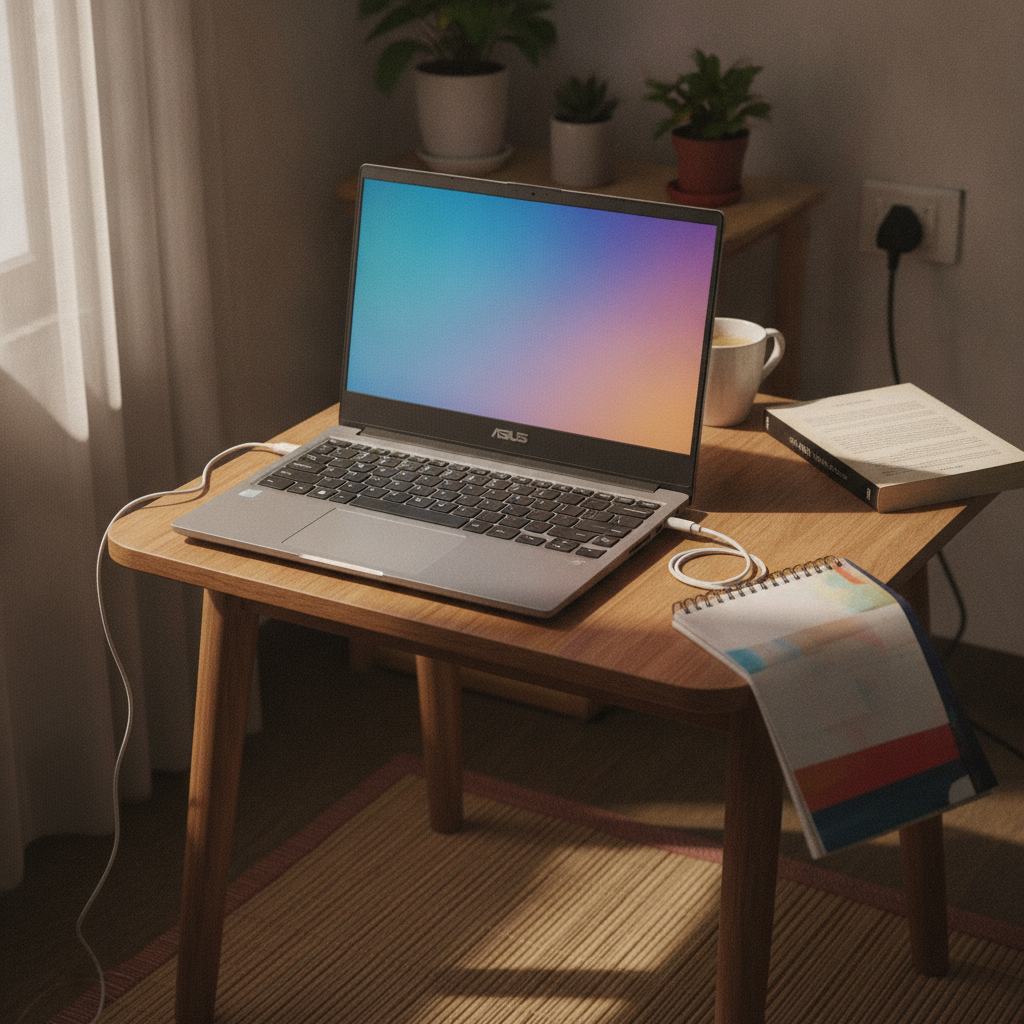
The Dell Pro 15 (2025) runs a Ryzen 5 7520U with 8GB of RAM and a 512GB SSD at roughly ₹44,490 (Sportskeeda, 8 August 2026). That is the same modest chip as the Vivobook Go, but the reason to look here is the display: a 15.6-inch FHD anti-glare panel that runs at 120Hz, when almost everything else under ₹50,000 is stuck at 60Hz. Scrolling looks smoother, the cursor sharper.
It is not a gaming feature here — the integrated graphics cannot push demanding games — but for anyone who reads all day it reduces eye strain. The rest is standard budget fare: plastic build, 8GB soldered LPDDR5 RAM, average battery. Treat it as a “great screen, modest engine” pick.
Pros
- 120Hz anti-glare FHD panel — rare at this price
- Smoother scrolling, easier on the eyes all day
- 512GB SSD, Dell’s India service network
- Around ₹44,490 as of August 2026
Cons
- Ryzen 5 7520U is a modest performer
- 8GB soldered RAM — no upgrade path
- Plastic build, average battery life
Lenovo IdeaPad Slim 3 — the strongest all-round engine, with a real RAM slot
The IdeaPad Slim 3 with a Ryzen 5 5625U (6 cores, 12 threads), 8GB RAM and a 512GB SSD sells for around ₹47,990 (Amazon.in via pricehistory.app, roughly June 2026). The 5625U is a proper six-core chip: for anything that leans on the processor for more than a few seconds — a video export, a compile, a big spreadsheet, batch photo edits — it holds speed better than the four-core 7520U in the Dell and the Vivobook Go. It also typically has one free SO-DIMM slot, so moving to 16GB later is cheap.
Build quality is solid for the price and Lenovo’s service network is wide. Watch the variant, though: the newer Ryzen 5 7520U / 16GB version (model 82XQ00XDIN) now lists closer to ₹53,990 (small-retailer quotes, August 2026), above ₹50,000 and cashback-dependent. Stick to the 5625U configuration and confirm the live spec.
Pros
- Six-core Ryzen 5 5625U holds speed under load
- Free SO-DIMM slot — easy upgrade to 16GB+
- Solid build, good keyboard, wide Lenovo service network
Cons
- Ships with only 8GB RAM
- 5625U is a 2022-era chip — efficient, not the newest
- Newer 16GB variant costs more and breaches ₹50,000
HP 15s (Ryzen 3 7320U) — a safe everyday pick only near the bottom of its range
The HP 15s with a Ryzen 3 7320U, 8GB soldered LPDDR5 RAM and a 512GB SSD runs from about ₹45,990 (cashkr.com, 30 August 2026) to ₹49,899 (Smartprix, 20 August 2026). The 7320U is a four-core chip for light work — browsing, YouTube, Office, online classes, calls. Load it with many heavy tabs plus an app plus a call and it slows down. You get an FHD screen and HP’s wide service network. If video-call quality is your priority, our best laptop for online classes guide covers camera, mic and battery specifically.
At ₹45,990 it is a reasonable household laptop. At ₹49,899 it makes no sense — for the same money the Lenovo IdeaPad Slim 3 gives you a stronger six-core chip and a RAM slot. It is this guide’s clearest case of a cheap-looking option that is not the value option: buy it only near ₹46,000 (prices as of August 2026), and check the live price on the day.
Pros
- Dependable for browsing, office work and streaming
- 512GB SSD, FHD screen, wide HP service network
- Good value near ₹46,000 (August 2026)
Cons
- Ryzen 3 7320U struggles once you load it up
- 8GB soldered RAM — no upgrade ever
- Poor value if priced near ₹50,000
Full specs and price comparison
These are August 2026 spot prices and move weekly — check live through the links.
| Model | CPU (cores/threads) | RAM | Storage | Display | RAM upgradeable? | Approx price (Aug 2026) |
|---|---|---|---|---|---|---|
| ASUS Vivobook 15 X1504VA | Core i5-1335U (10C/12T) | 8GB | 512GB NVMe SSD | 15.6″ FHD IPS 60Hz | Usually 1 free slot — verify SKU | ~₹44,000–48,000 |
| ASUS Vivobook Go 15 E1504FA | Ryzen 5 7520U (4C/8T) | 16GB | 512GB NVMe SSD | 15.6″ FHD 60Hz | No (soldered) | ~₹41,990 |
| Dell Pro 15 (2025) | Ryzen 5 7520U (4C/8T) | 8GB LPDDR5 | 512GB NVMe SSD | 15.6″ FHD 120Hz anti-glare | No (soldered) | ~₹44,490 |
| Lenovo IdeaPad Slim 3 | Ryzen 5 5625U (6C/12T) | 8GB | 512GB NVMe SSD | 15.6″ FHD 60Hz | Yes — 1 SO-DIMM slot | ~₹47,990 |
| HP 15s (Ryzen 3 7320U) | Ryzen 3 7320U (4C/8T) | 8GB LPDDR5 | 512GB NVMe SSD | 15.6″ FHD 60Hz | No (soldered) | ~₹45,990–49,899 |
8GB vs 16GB RAM: Which Should You Choose?
At ₹50,000 in 2026 you usually choose between a newer, faster processor with 8GB of RAM and an older, slower one with 16GB. Deciding which matters more for your use is the key call.
Take the 16GB (older chip) if you keep 15–20+ tabs open, run several apps at once, do light Photoshop or Lightroom, or run Android Studio or virtual machines. Run out of RAM and the laptop swaps to the SSD and crawls — a faster CPU cannot rescue that. The ASUS Vivobook Go 15 is the pick.
Take the 8GB (newer chip) if your work is focused — study, office documents, browsing, media, calls, one or two apps at a time — and the machine has a free RAM slot for a cheap upgrade later. Do not pay for soldered 8GB on a laptop you will keep five years; that ceiling is permanent. The cheapest genuine 16GB option is the 2024 ASUS Vivobook 15 (Core i5 11th Gen, 16GB, 1TB SSD) at roughly ₹41,991 (cashkr.com, 30 August 2026) — an older CPU, but plenty of RAM and storage. If ₹50,000 is more than you want to spend, our best laptop under ₹35,000 guide covers the cheaper end.
₹40,000 vs ₹50,000 vs ₹60,000: Which Laptop Budget Is Right for You?
₹50,000 is where the basics — NVMe SSD, FHD IPS screen, current-ish CPU — stop being a compromise. Below it you gamble on the screen and CPU; above it the RAM-versus-speed trade-off goes away.
Spend around ₹40,000 if
Your use is genuinely light — browsing, typing, YouTube, classes — and you accept 8GB RAM, an older processor and a weaker panel, but never a mechanical hard drive. A second household or student browsing laptop. Our best laptop under ₹40,000 guide breaks down this tier in detail.
Spend around ₹50,000 if
You want one reliable laptop for daily work or study: an FHD IPS screen, a 512GB SSD, a current i5 or six-core Ryzen 5, and 16GB now or 8GB with a free slot. Every pick here fits.
Stretch to ₹60,000 if
You need a guaranteed 16GB and a current-generation i5 or Ryzen 5 in one machine, plus a better build; the extra ₹10,000 removes this guide’s core compromise. Our best laptop under ₹60,000 guide explores this tier for everyday productivity. It is also where a discrete GPU starts, so for gaming see our best gaming laptop under ₹60,000 in India guide.
How and when to buy a laptop under ₹50,000 in 2026
The best time to buy is during a major sale — Amazon Great Indian Festival or Flipkart Big Billion Days — when budget laptops are cheapest. Run these checks first.
- Set specs and RAM path: a 15.6″ FHD IPS screen, a 512GB NVMe SSD (never HDD or eMMC), a current-generation CPU, and 16GB now or 8GB on a chip with a free SO-DIMM slot.
- Match the listing’s exact model number to this guide — one marketing name hides very different chips and panels.
- Compare Amazon.in and Flipkart on the same day with card offers; our best laptop deals in India’s festive sale guide explains sale pricing.
- Check the brand’s local service centre — our HP vs Dell vs Lenovo comparison covers warranty and after-sales — then buy once price and spec line up, not for a promised 2026 refresh that only cuts specs.
Frequently asked questions
Which laptop is best under ₹50,000 in India in 2026?
The ASUS Vivobook 15 (X1504VA) is the best all-round pick under ₹50,000 for most people, pairing the newest processor in this bracket (Core i5-1335U, 13th Gen) with an FHD IPS screen and a 512GB SSD at around ₹44,000–48,000 (as of August 2026). Its one weakness is 8GB of RAM, so budget ₹1,800–2,500 for an extra stick. Heavy multitaskers should take the 16GB ASUS Vivobook Go 15 instead.
Is 8GB RAM enough for a laptop in 2026?
8GB of RAM is the workable minimum for Windows 11 in 2026 — fine for office work, a dozen browser tabs, streaming, calls, and one or two apps at a time. It is not enough for 20-plus tabs or for photo and video editing, where the machine uses the SSD as memory and slows sharply. If you buy an 8GB laptop, choose one with a free RAM slot so you can move to 16GB later. If video editing is the goal, skip this tier and read our best laptop for video editing in India instead.
Is Intel Core i5 or AMD Ryzen 5 better in a budget laptop?
Core i5 versus Ryzen 5 matters less than the exact chip at this price. A current Core i5-1335U (13th Gen) or a six-core Ryzen 5 5625U will outperform a four-core Ryzen 5 7520U on sustained tasks, even though all three carry a “5-series” badge. Check the core count and generation, not just the name. For general use any is fine; for compiling, exports or big spreadsheets, favour the six-core or 10-core options.
Can you play games on a laptop under ₹50,000?
Gaming on a laptop under ₹50,000 is limited to light, older and esports titles at low settings — Valorant, GTA V and older FIFA run on the integrated graphics these machines use. Modern AAA games do not, because there is no discrete graphics card at this price. If gaming is a real priority, a discrete GPU starts at around ₹60,000; see our best gaming laptop under ₹60,000 guide. There is one narrow exception worth checking first: our best gaming laptop under ₹50,000 guide covers the single dedicated-GPU model that still clears this lower bar.
Which laptop under ₹50,000 is best for engineering and CS students?
Engineering and computer-science students should favour RAM and cores over screen refresh rate. The Lenovo IdeaPad Slim 3 (six-core Ryzen 5 5625U, free RAM slot) is the best base — take it to 16GB cheaply for Android Studio, VMs and compiling. If you want 16GB from day one, the ASUS Vivobook Go 15 works but is slower. For heavier workloads, our best laptop for programmers in India guide covers options from this budget upward.
How much RAM and storage can I upgrade later on these laptops?
Upgrade room varies by model, so check the exact SKU. The Lenovo IdeaPad Slim 3 (5625U) typically has one free SO-DIMM slot for an 8GB or 16GB stick, and the ASUS Vivobook 15 X1504VA has a free slot on most variants. The ASUS Vivobook Go 15, Dell Pro 15 and HP 15s use soldered LPDDR5 RAM with no RAM upgrade path. Nearly all have an M.2 slot, so the SSD can usually be swapped for a larger one.
Check today’s prices before you buy — this budget moves weekly:

Written by Vaibhav Kulkarni
Vaibhav is the founder and technical editor of TheTechVector, with 15 years’ experience in quality engineering and software testing. He applies that background to auditing spec sheets, comparing price-to-performance, and checking hardware compatibility across our India laptop and TV buying guides. All prices are checked before publication — if something’s out of date, let us know.
Affiliate disclosure: This article contains affiliate links. TheTechVector may earn a commission if you purchase through these links, at no additional cost to you. As an Amazon Associate, we earn from qualifying purchases. We only recommend products we have researched independently. Prices correct at time of publication — always check the retailer’s site for the latest price. Last reviewed: August 2026.